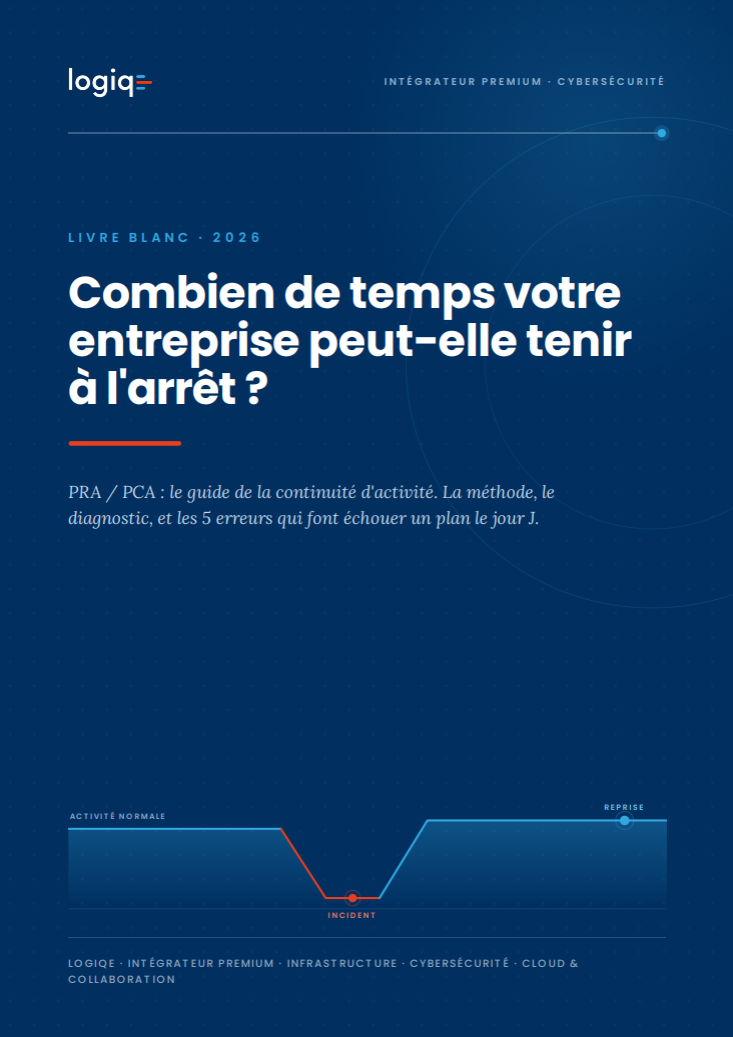
Ensure the continuity of your critical services
Business continuity is no longer a luxury, but a regulatory and strategic requirement. Whether facing a cyberattack, hardware failure, or natural disaster, your organization must be able to quickly restart its essential services.
LOGIQE supports you in the design, implementation, and testing of your Business Continuity Plan (BCP), with a rigorous, tool-based approach aligned with your business challenges.
A PRA tailored to your constraints and your IT system
The Disaster Recovery Plan (DRP) is a technical and organizational mechanism that enables critical information systems to be quickly restored after a major incident. It is based on a detailed assessment of risks, dependencies, and business priorities.
LOGIQE works with you to build a customized DRP, taking into account your architecture (on-premise, cloud, hybrid), your compliance requirements (ISO 27001, HDS, GDPR, NIS2, etc.), and your budgetary constraints.
The pillars of an effective disaster recovery plan
We structure your PRA around four key dimensions:
Identification of critical services
Mapping of applications, databases, infrastructure services, and business processes.
Setting recovery objectives
Realistic RTO (Recovery Time Objective) and RPO (Recovery Point Objective), based on your business impacts.
Technical implementation
Replication, snapshots, external backups, automatic failovers, backup environment (cluster, VM, cloud).
Testing and documentation
Planned test scenarios, detailed procedures, crisis communication plan, team training.
Proven technologies to help you get back to business
Our experts rely on robust solutions to ensure the reliability of your disaster recovery plan:
- Veeam for instant backup and recovery
- VMware SRM or Hyper-V Replica for VM replication and failover
- Azure Site Recovery for disaster recovery in the cloud
- SAN/NAS snapshots (Synology, QNAP, NetApp) with immutable locking
- Automation via PowerShell scripts or third-party orchestrators
Each component is chosen based on your existing infrastructure and recovery objectives. LOGIQE guarantees seamless integration with your virtualized systems, directories (Active Directory), application servers, and Microsoft 365 services.
PRA vs PCA: complementary answers
The Disaster Recovery Plan (DRP) is often confused with the Business Continuity Plan (BCP). While the BCP aims to maintain operations without interruption, the DRP comes into play after an incident to restore activity within a predefined timeframe.
LOGIQE can assist you with both aspects, in conjunction with your IT department and your business units. In certain contexts, a combined PRA + PCA approachis essential (healthcare, industry, local authorities, etc.).
LOGIQE support: from diagnosis to switchover testing
We are involved at every stage:
- PRA/PCA maturity audit
- Business Impact Analysis (BIA)
- Recovery architecture diagram
- Writing the plan and procedures
- Implementation of the technical solution
- Planned or real-life tests
- Support and regular updates of the PRA
Each project is fully documented and shared with your technical teams, CIO, CISO, or external service providers.
Why entrust your PRA to LOGIQE?
- Infrastructure and cybersecurity expertise: we secure technical recovery and post-incident access
- Compliance assured: alignment with ISO, HDS, GDPR, and SecNumCloud requirements
- Long-term support: annual testing, continuous improvement, plan updates
- Mastered ecosystem: Veeam, VMware, Azure, Hyper-V, Proxmox, Synology
- Proactive support and customized SLAs
FAQ – Business Continuity Plan
What is the difference between RTO and RPO?
The RTO (Recovery Time Objective) is the maximum acceptable downtime. The RPO (Recovery Point Objective) is the maximum amount of data you can afford to lose. LOGIQE helps you define these thresholds according to your business risks.
Is a physical backup site really necessary?
No. It is possible to set up a cloud disaster recovery plan (via Azure, for example) or to use a remote cluster or replication to a remote NAS. We tailor the solution to your requirements.
When should a disaster recovery plan be tested?
At least once a year, or whenever there is a major change to your IT system. LOGIQE offers scheduled tests or tests in a pre-production environment.